

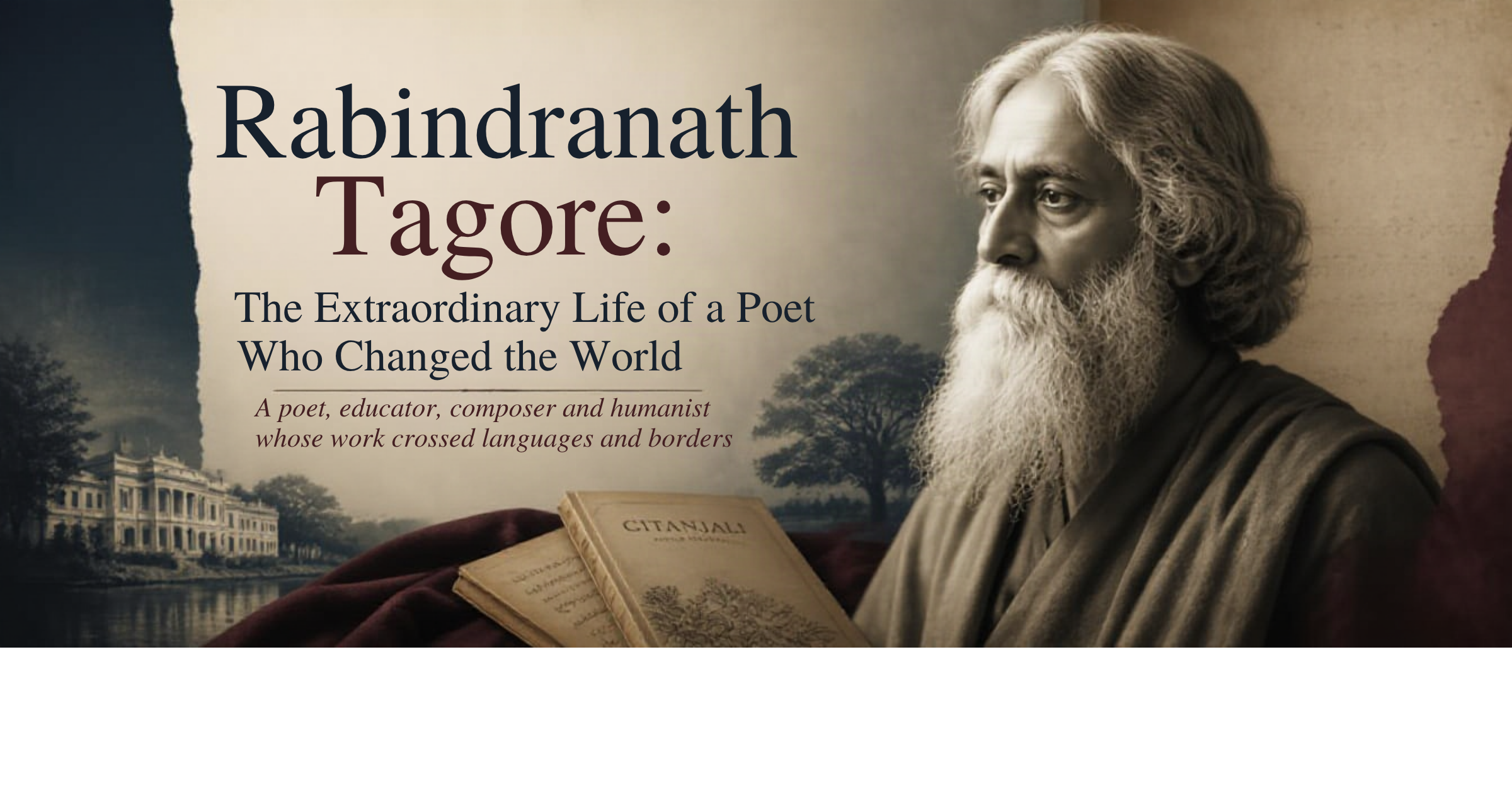
Introduction
In November 1913, news from Stockholm gave global recognition to a literary voice formed in Bengal. Rabindranath Tagore became the first non-European recipient of the Nobel Prize in Literature, an achievement that brought his English-language poetry to readers who had never encountered Bengali literature before.
The award was important, but it was only one moment in a much larger life. Tagore was a poet, philosopher, novelist, short-story writer, playwright, composer, painter, educator and public thinker. He wrote about nature and spiritual longing, created songs that entered public life, founded an ambitious school at Santiniketan and argued that education should develop the whole person.
This Rabindranath Tagore biography follows his life story from the Jorasanko household to the world stage, while also considering the ideas, creative work and modern interpretations that keep his legacy alive.
Rabindranath Tagore at a Glance
| Event | Date | Significance |
| Born in Calcutta, now Kolkata | 7 May 1861 | Entered a family shaped by literature, reform and the arts |
| Married Mrinalini Devi | 1883 | Began family life while developing his literary career |
| Founded the Santiniketan school | 1901 | Put his educational ideas into practice |
| Bengali Gitanjali published | 1910 | Presented a major body of devotional and philosophical poems |
| English Gitanjali: Song Offerings | 1912 | Introduced selected, adapted poems to international readers |
| Nobel Prize in Literature | 1913 | Became the first non-European literature laureate |
| Renounced British knighthood | 1919 | Protested the Jallianwala Bagh massacre |
| Visva-Bharati formally established | 1921 | Expanded Santiniketan into a meeting place for learning |
| Died in Calcutta | 7 August 1941 | Left a wide literary, musical and educational legacy |
Early Life and Childhood
Rabindranath Tagore was born on 7 May 1861 in Calcutta, now Kolkata, into the influential Tagore family of Jorasanko. The household was a centre of intellectual and artistic activity, with relatives involved in literature, music, theatre, philosophy, social reform and visual art.
His father, Debendranath Tagore, was an important figure in the Brahmo Samaj, a reform movement that questioned inherited religious conventions and encouraged ethical and spiritual reflection. This atmosphere exposed the young Tagore to debate, study and creative work rather than a single narrow tradition.
Tagore was educated mainly at home by tutors and through independent reading. He encountered Bengali and Sanskrit literature, English writing, music, theatre, art, philosophy and the natural world. Conventional schooling did not suit him for long, and this shaped his later belief that learning should be active, humane and connected to life.
He spent time in England as a young man but did not complete a university degree. His education instead grew through reading, observation, travel, family influence and sustained creative practice. That unconventional path became an important part of the Rabindranath Tagore life story.
The Young Poet Finds His Voice
Tagore began writing verse while still young, during a period often associated with the Bengali Renaissance. Bengal was experiencing fresh thinking in literature, education, religion and social reform, and Tagore helped carry that energy into modern Bengali writing.
His imagination was not limited to private emotion. He paid attention to village life, rivers, seasons, family relationships, workers, children and the pressures created by social change. These observations gave his writing a human scale and helped him bring new rhythms and subjects into Bengali literature.
The phrase Rabindranath Tagore poems covers a wide emotional range: devotion, love, loneliness, joy, death, injustice and wonder before nature. He treated poetry not as an escape from reality, but as a way to look at reality with greater patience and honesty.
Family, Personal Life and Challenges
Tagore married Mrinalini Devi in 1883, and they had five children. His adult life combined creative achievement with responsibilities that were personal, practical and public.
Mrinalini died in 1902. In the years that followed, Tagore also experienced the deaths of his daughter Renuka, his son Samindranath and his father, Debendranath Tagore. These losses occurred alongside the demands of writing, managing family estates, building an institution and responding to the pressures of colonial India.
The historical record does not justify invented private scenes or simplified claims about how he processed grief. It does show that loss formed part of the circumstances surrounding his mature work. His writing often returns to mortality, absence, spiritual longing and renewal without making sorrow seem easy.
Managing family estates also brought him closer to rural Bengal and to the realities faced by people outside privileged urban circles. That experience strengthened his interest in social dignity, village life and reform, concerns that appear in different forms across his fiction, essays and educational work.
Gitanjali by Rabindranath Tagore
The Bengali collection Gitanjali, meaning “Song Offerings,” was published in 1910. Two years later, an English volume titled Gitanjali: Song Offerings reached a wider readership.
The English book should not be described as a simple line-by-line translation of the Bengali collection. It was a selected and adapted translation that included poems drawn from more than one Bengali volume. Tagore reshaped the material for English readers while carrying across its spiritual seriousness and lyrical movement.
The poems consider the relationship between the individual and the divine, the discipline of humility, the presence of nature, love and loss, and the desire to move beyond fear and narrowness. Their language is reflective, but the questions are widely human: How should a person live? What does freedom require? How can beauty and suffering be held together?
The English volume attracted attention in Britain and elsewhere, helping readers encounter a poetic voice rooted in Bengali language and culture. Its reception was significant, but it should not erase the much larger Bengali body of work from which the book emerged.
The 1913 Nobel Prize
In 1913, Tagore received the Nobel Prize in Literature. The Nobel Committee praised his “profoundly sensitive, fresh and beautiful verse” and recognised his ability to bring poetic thought, expressed in English, into Western literature.
He became the first non-European Nobel laureate in Literature. The Rabindranath Tagore Nobel Prize was therefore a landmark in global literary history, while also being the result of decades of Bengali poetry, fiction, drama, music and public thought—not the achievement of one translated book alone.
A Writer Beyond Poetry
Tagore’s range is one reason a short description of him as “the Nobel poet” feels incomplete. He worked across forms, allowing ideas to move between story, song, theatre, essay, image and classroom.
Short stories
His short stories examine family life, class, gender, childhood, rural society and moral conflict. Many bring readers close to people whose experiences might otherwise remain outside the attention of privileged society.
Novels
Novels such as Gora, The Home and the World (Ghare-Baire) and Yogayog explore identity, religious difference, nationalism, social change and the pressure that politics and tradition can place on individual lives.
Plays, essays and music
His plays and dance dramas include The Post Office (Dak Ghar), Red Oleanders (Raktakarabi) and The King of the Dark Chamber (Raja). His essays extend his thinking about society, education, culture and nationalism.
Tagore wrote the words and music for more than 2,000 songs, now commonly known as Rabindra Sangeet. These songs address devotion, love, patriotism, seasons, grief and celebration, showing how closely music was woven into his creative life.
In later life, he also became a serious painter. His visual art was expressive and experimental, another sign that he continued to explore unfamiliar forms rather than remain inside the role that had made him famous.
The Educator Who Imagined a Different School
In 1901, Tagore founded an experimental school at Santiniketan in rural Bengal. He wanted education to be more than the memorisation of information for examinations, but his vision was not a simplistic rejection of structure. It was an effort to make learning more connected, curious and humane.
His educational philosophy valued learning in close contact with nature, opportunities for questioning, and the serious place of music, art, literature and craft. It also brought together Indian traditions and global learning, encouraging students to see culture as a conversation rather than a wall.
Santiniketan later developed into Visva-Bharati, formally established in 1921 as a meeting place between India and the world. Tagore hoped education would cultivate independence, sensitivity and responsibility alongside knowledge.
His Connection with India and the World
Tagore supported freedom from British colonial rule, yet he was wary of aggressive or narrow nationalism. He believed love of country should not require hostility toward other peoples, and that a free society should protect human dignity while remaining open to cultural exchange.
The British government knighted him in 1915. After the Jallianwala Bagh massacre in 1919, he renounced the honour in protest. This was a documented public act, not a reason to turn his life into a flawless political legend.
Tagore and Mahatma Gandhi respected one another, while sometimes differing about methods and emphasis. Their relationship illustrates two powerful approaches to India’s future: both concerned with human welfare, but not identical in their understanding of politics, education and social change.
Jana Gana Mana and Amar Shonar Bangla
Jana Gana Mana
Tagore wrote “Jana Gana Mana” in Bengali, and it was first publicly sung in 1911. The first stanza was adopted as India’s national anthem on 24 January 1950. Its words address a guiding force connected with India’s collective destiny; the song should not be repeated as the inaccurate claim that it was written to praise a British monarch.
Amar Shonar Bangla
Tagore wrote “Amar Shonar Bangla” in 1905 during the movement against the first partition of Bengal. The song expresses love for Bengal’s landscape, language and cultural life. Its opening lines were adopted as Bangladesh’s national anthem in 1971.
Tagore’s connection with the national anthems of India and Bangladesh is historically remarkable, but it should not be used to suggest that his work alone created either country’s national identity. These songs became part of wider histories of language, politics, memory and public life.
Seven Inspiring Life Lessons
- Practise creativity. Tagore worked across poetry, fiction, theatre, music, education and painting, showing how creative habits can grow through repeated effort.
- Keep learning. His unconventional education reminds us that curiosity can continue beyond classrooms, degrees and formal credentials.
- Choose compassion. His stories often direct attention toward ordinary people, unequal relationships and the human cost of social indifference.
- Protect independent thought. Tagore supported freedom while questioning narrow nationalism, suggesting that loyalty should not require surrendering conscience.
- Stay close to nature. Rivers, seasons, trees and open spaces shaped both his writing and his educational vision.
- Meet grief honestly. His life included major losses, yet his work continued to search for meaning without pretending that sorrow is simple.
- See humanity beyond borders. His ideal of cultural exchange encourages people to love their own language and heritage while remaining open to other lives and ideas.
Final Years and Lasting Legacy
During his final years, Tagore continued to write, paint and speak about the dangers facing humanity. His health declined, but his creative energy remained active. He supported Santiniketan and Visva-Bharati while reflecting on war, colonialism, violence and the failure to treat human beings with dignity.
Tagore died in Calcutta on 7 August 1941, at the age of 80. His influence did not end with his death. His poems continue to be translated and performed, Rabindra Sangeet remains central to Bengali cultural life, and his fiction continues to be adapted for theatre, film and television.
Visva-Bharati remains associated with his educational vision, while the national anthems of India and Bangladesh keep his words present in public memory. His work also continues to prompt debate about creativity, nationalism, cultural exchange and the purpose of education.
Tagore did not leave one simple message. He left a living body of work that invites readers to think freely, feel deeply and meet other people with greater understanding.
Conclusion: Why Rabindranath Tagore Still Matters
The Rabindranath Tagore life story reminds us that greatness need not fit inside one profession or one language. He wrote, composed, taught, painted and questioned. He could love India deeply while resisting hatred, and he could value tradition while remaining open to the world.
For readers today, his most useful lesson may be the importance of continuing to create and learn. In a culture that often rewards speed and imitation, Tagore’s legacy makes room for attention, imagination and courage. The next step is not simply to admire his work, but to carry its humanising spirit into the way we learn, create and live with others.
Frequently Asked Questions
Who was Rabindranath Tagore?
Rabindranath Tagore was a Bengali poet, writer, composer, playwright, painter, educator and public thinker. Born on 7 May 1861 in Calcutta, he became the first non-European Nobel Prize laureate in Literature in 1913.
Why did he win the Nobel Prize?
He received the 1913 Nobel Prize in Literature for poetry the Nobel Committee described as profoundly sensitive, fresh and beautiful. His English-language Gitanjali: Song Offerings helped bring his work to international readers.
What is Gitanjali?
Gitanjali is a Bengali collection of devotional and philosophical poems published in 1910. The English Gitanjali: Song Offerings, published in 1912, contained selected and adapted poems from more than one Bengali collection.
What did Tagore establish at Santiniketan?
He founded an experimental school at Santiniketan in 1901. The project later developed into Visva-Bharati, formally established in 1921 as a centre for learning and cultural exchange.
Which national anthems are associated with Tagore?
Tagore wrote “Jana Gana Mana,” whose first stanza became India’s national anthem in 1950, and “Amar Shonar Bangla,” whose opening lines became Bangladesh’s national anthem in 1971.
What can we learn from his life?
Modern readers may draw lessons about creativity, lifelong learning, compassion, independent thought, appreciation of nature, courage and respect for humanity across borders.